


Description
PrymaLab · Research Use Only
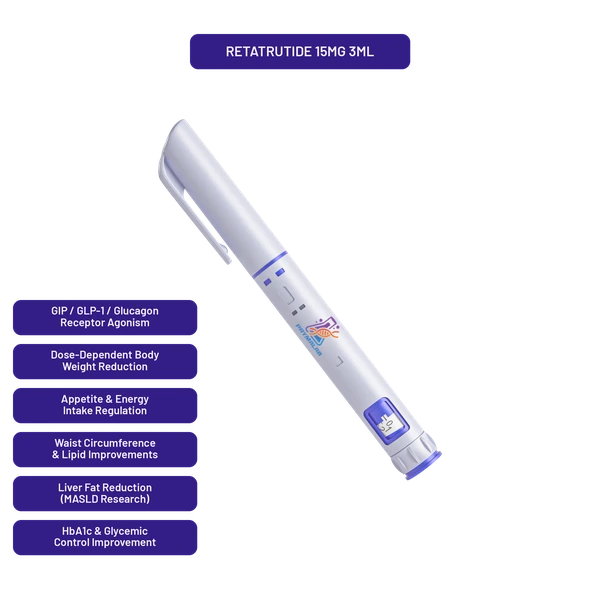
Preloaded Autoinjector | Retatrutide | 3ml Pen | 15mg
Lipidated triple agonist in solution · 3ml at 15/3 mg/ml · No reconstitution step
The retatrutide pen is a preloaded 3ml research autoinjector containing retatrutide (LY3437943) in solution at 15/3 mg/ml, giving 15mg of the lipidated 39-residue triple agonist per device. With no cysteine, methionine, tryptophan or asparagine in the chain, the solution behaviour that matters is physical rather than covalent: the C20 fatty diacid on Lys17 drives self-association and adsorption, neither of which shows up on a purity assay.
Specification Table
| Property | Value |
|---|---|
| Device format | Preloaded autoinjector pen, glass cartridge |
| Fill volume | 3 ml |
| Concentration | 15/3 mg/ml |
| Total compound in device | 15 mg |
| Molar concentration | Approximately 0.0705 × 15 mM (70.5 × 15 µM) |
| Compound | Retatrutide (LY3437943), lipidated 39-residue GIP, GLP-1 and glucagon receptor triagonist |
| CAS number | 2381089-83-2 (free peptide; acetate, TFA and sodium salts share the same peptide) |
| Molecular formula | C221H342N46O68 (free peptide) |
| Molecular weight | 4731.3 g/mol (average) |
| Amino acid sequence | Tyr-Aib-Gln-Gly-Thr-Phe-Thr-Ser-Asp-Tyr-Ser-Ile-(alpha-Me-Leu)-Leu-Asp-Lys-Lys(C20 diacid via gamma-Glu and one AEEA)-Ala-Gln-Aib-Ala-Phe-Ile-Glu-Tyr-Leu-Leu-Glu-Gly-Gly-Pro-Ser-Ser-Gly-Ala-Pro-Pro-Pro-Ser-NH2 |
| Solution appearance | Not published on the product record. Intact solutions of this class are clear and colourless |
| Reconstitution required | None. Supplied as solution |
| Excipient system | Not published on the product record. Confirm against certificate of analysis |
| Solution pH | Not published on the product record |
| Storage | 2-8°C, protected from light. Do not freeze |
| Light sensitivity | Moderate. Three Tyr residues can photo-oxidise; no Trp chromophore |
| Solution stability | Not established over device shelf life. No retatrutide-specific forced-degradation study located |
| Lipidation | Eicosanedioic acid (C20 diacid) on Lys17 through a gamma-glutamyl residue and one AEEA spacer |
| Self-association | Reversible, concentration-dependent oligomers driven by the C20 diacid; adsorbs to glass and polymer |
| Salt form | Not published on the product record. Research material is typically acetate or trifluoroacetate |
| Purity | Per lot-specific certificate of analysis |
| Regulatory status | No approved product in any jurisdiction. Investigational (Eli Lilly); phase 3 TRIUMPH programme ongoing |
What Changes When Retatrutide Ships in Solution?
Less covalent chemistry than for most peptides, and more physical chemistry: retatrutide has no cysteine, methionine, tryptophan, asparagine or histidine, so the fast degradation routes are absent, and what dominates in water is the behaviour of the C20 fatty diacid on Lys17.
The chain is 39 residues with a C-terminal serinamide, 2-aminoisobutyric acid (Aib) at positions 2 and 20, alpha-methyl-leucine at position 13, and Lys17 acylated with eicosanedioic acid through a gamma-glutamyl residue and one AEEA spacer. The Tyr-Aib N-terminus lacks the proline or glycine that makes diketopiperazine loss of the first two residues fast in other peptides, so what remains is a slow file. Tyr1, Tyr10 and Tyr25 can oxidise under light or trace-metal catalysis, a +16 Da change any mass spectrometer sees. Gln3 and Gln19 can deamidate at +0.98 Da, orders of magnitude more slowly than asparagine would. Asp9 and Asp15 can isomerise to isoaspartate, mass-silent because the isomer is isobaric, though neither sits in an Asp-Gly or Asp-Pro motif. The terminal amide hydrolyses at +1 Da over months.
The dominant solution feature is the lipid. Eicosanedioic acid is a 20-carbon chain with a carboxylate at each end; the free end stays charged at neutral pH while the chain is hydrophobic, so the molecule is an amphiphile: a 4.7 kDa peptide carrying six carboxylates against one free lysine and the N-terminal amine, with a C20 tail hanging off the middle. Lipidated incretins of this design form reversible, concentration-dependent oligomers in water, and the same tail binds serum albumin, which is where the half-life of about 6 days reported by Urva 2022 comes from (Coskun 2022). Those oligomers are mass-silent and purity-silent: they dissociate in the mobile phase of an HPLC run and in the electrospray source, so a certificate showing 99% purity says nothing about whether the solution was monomeric or micellar when it was drawn. An amphiphile at low concentration also coats glass and polymer unless a surfactant or carrier protein is present, and a cartridge, its plunger and every downstream pipette tip are surfaces.
One chemistry check is worth running on any vendor sheet before ordering. The free-peptide formula C221H342N46O68 and the average mass of 4731.3 g/mol are consistent with a single AEEA spacer in the Lys17 linker. A second AEEA unit, which many listings describe as “2 x OEG”, would add about 145 Da (to roughly 4876) and a 47th nitrogen. A certificate reporting an observed mass near 4876 describes a different molecule from the one in PubChem CID 171934787 and in the Lilly patent WO2020023386A1.
No retatrutide product is approved, so the nearest formulation precedent is tirzepatide (Mounjaro), another Aib-containing C20 diacid incretin from the same company. That product is a clear, colourless aqueous solution at pH 6.5 to 7.5; its 0.5 ml single-dose presentation contains sodium chloride (4.1 mg) and sodium phosphate dibasic heptahydrate (0.7 mg) in water and nothing else, while the multidose KwikPen adds phenol, benzyl alcohol and glycerin. Label storage is 2-8°C, up to 21 days permitted at or below 30°C, protected from light, never frozen. Two lessons follow for a 3 ml research cartridge: the class is stable enough in plain phosphate-buffered saline near neutral pH to be sold as a solution, and a container entered repeatedly needs an antimicrobial preservative, a field this product record does not state.
No retatrutide-specific forced-degradation study was located in the peer-reviewed literature. Everything above is inference from residue chemistry and from the approved members of the class, and it should be read that way.
Retatrutide Pen How Many Clicks Make One Milligram?
On a device graduated at 0.01 ml per click, one milligram takes 300/15 clicks, because each click carries 15/300 mg; the graduation of this specific device is not stated on the product record and must be confirmed first.
The arithmetic starts from the fill. The device holds 15mg in 3 ml, which is 15/3 mg/ml. Dividing by the molecular weight of 4731.3 g/mol gives 0.0705 × 15 mM, or 70.5 × 15 micromolar. A 0.01 ml increment, the volume marked as one unit on an insulin-pattern scale, carries 15/300 mg, which is 3.33 × 15 micrograms; a 0.1 ml increment carries 15/30 mg, or 33.3 × 15 micrograms.
A worked example makes the scale concrete, and the strength in it is hypothetical. At 24 mg per pen the concentration is 8 mg/ml and 1.69 mM, and each 0.01 ml click carries 80 micrograms. The receptor work of Li 2024 used nanomolar ligand, so that solution sits more than a million-fold above the assay range.
The query “retatrutide pen how many clicks” has no single answer, because a click is a volume and a volume becomes a mass only once the fill concentration is fixed. The peptide calculator does that multiplication for any strength.
Can You Get Retatrutide in a Pen?
Yes as a research-use-only device such as this one, and no as a licensed medicine: no regulator has approved any retatrutide product, so every retatrutide injector pen sold anywhere is a vendor-filled research preparation rather than an Eli Lilly product.
Does retatrutide come in a pen from the originator? Not yet; TRIUMPH-1 and TRIUMPH-3 reached primary completion in April 2026 and no marketing authorisation had followed by September 2026. Is retatrutide available in a pen for laboratory work? It is, in the cartridge format described on the preloaded autoinjector category page, which sets out the six fields to confirm before ordering: fill date, verified concentration, buffer and pH, graduation resolution, cartridge material and cold-chain history.
Retatrutide in pen form is at least consistent with how the compound was studied, since every human trial used an aqueous solution injected subcutaneously once weekly. Consistency of format is not evidence of equivalence, and no controlled data exist on any vendor-supplied fixed-concentration retatrutide solution.
Retatrutide Pen vs Vial: What Does the Format Suit?
The retatrutide pen vs vial decision turns on whether the work needs many equal draws of a lipidated peptide from one lot, which favours the pen, or a buffer and concentration chosen at the bench, which favours the lyophilized vial.
For an amphiphile the reconstitution step carries a cost a plain peptide does not: foaming on swirling, adsorptive loss to the vial wall and the transfer syringe, and an uncertain fraction left behind on every surface. A cartridge filled once at manufacture removes the transfer, at the price of an excipient system the buyer did not choose. The general case is laid out in the pen versus vial comparison.
The lyophilized retatrutide 10mg vial suits receptor and cell work, where the assay buffer matters and the starting concentration should be low enough to keep the dilution series short. Retatrutide solution vs lyophilized is a question of who controls the buffer: with the vial, the laboratory does; with the pen, the filler did, and did not publish it.
Retatrutide pen price sits on the product record and is not quoted here because it changes. The useful comparison is cost per milligram of peptide confirmed by certificate against the same figure for a vial, minus the fraction of a vial that adsorbs during transfer, a loss rarely measured and never zero for a lipidated peptide. The retatrutide and tirzepatide comparison covers why the tirzepatide formulation is the only published benchmark for this class, and the retatrutide buying guide covers what a certificate should show.
What the Product Record Does Not State
Five fields that determine what this solution is are absent from the product record: the excipient system, the preservative, the pH, the salt form of the peptide, and the fill date from which the stability clock runs.
Whatever buffer, tonicity agent and preservative are present enter every assay the solution touches, and preservatives are not inert toward lipidated peptides: phenol and benzyl alcohol, the two used in the multidose tirzepatide pen, influence peptide conformation and self-association, which is why formulators screen them rather than assume them.
Solution pH governs the physical behaviour. The chain carries six carboxylates against one free lysine and the N-terminal amine, so net charge near neutral pH is approximately minus four and solubility falls as pH moves toward the acidic isoelectric region. An unstated pH also leaves the deamidation and amide-hydrolysis rates unknown, because both are pH-dependent.
The salt form is unstated, and research retatrutide is sold as the acetate or the trifluoroacetate, with residual TFA not neutral in cell assays. The fill date is unstated, and with it the position of the device on a stability curve nobody has published. Confirm all five against the certificate of analysis before quantitative work, not after an anomalous result.
Verifying the Retatrutide Pen Before Use
Inspect the solution against a dark and a white background before each draw: it should be clear and colourless, and any opalescence, haze or particulate is a change in the physical state of an amphiphilic peptide that has not been characterised for this fill.
Opalescence is the signature to watch for. Reversible oligomers are too small to scatter light; a visible haze means association has progressed to larger species, or that peptide has come out of solution near its isoelectric region. Neither is reversed by warming, and shaking adds shear and air-water interface, the condition that drives lipopeptides to aggregate.
Let the device reach ambient temperature before actuating, since a lipidated peptide solution is more viscous cold and spring-driven mechanisms deliver less volume against a viscous load. For an amphiphile there is a second reason to prime: the first fraction to leave a fresh cartridge is the fraction most likely depleted by adsorption.
What Would Confirm the Contents Are Intact?
Two measurements answer two different questions: intact-mass LC-MS tells whether the retatrutide molecule has changed, and a content assay tells how much of it is still in solution, and for this lipidated peptide the second can fall while the first stays at 99%.
Intact mass should sit at an average of 4731.3 Da. Tyrosine oxidation appears as +16 Da and is visible on any instrument. Deamidation of Gln3 or Gln19 and hydrolysis of the terminal amide are each about +1 Da, resolvable on a high-resolution instrument and easy to miss on a low-resolution one. Isoaspartate at position 9 or 15 is invisible by mass and needs peptide mapping. None of these reports the oligomer state, because oligomers dissociate in the acetonitrile gradient before the detector sees them.
Content is the measurement that matters for a cartridge drawn from over weeks, and quantitative reversed-phase HPLC against a weighed reference standard is the direct route. The three tyrosines give a weak absorbance at 280 nm, roughly 4,500 per molar per centimetre, enough for a content check but not for detecting a loss of a few percent; there is no tryptophan to help. Size-exclusion chromatography or dynamic light scattering reports the oligomer distribution, and thioflavin T reports fibrils.
What Does the Retatrutide Literature Actually Report?
Four human trials carry the evidence: Urva 2022 (n=72, 12 weeks, type 2 diabetes), Jastreboff 2023 (n=338, 48 weeks, obesity), Rosenstock 2023 (type 2 diabetes) and Sanyal 2024 (n=98, MASLD substudy), all using once-weekly subcutaneous injection in supervised settings.
Coskun 2022 is the discovery paper, reporting weight loss, improved glycaemia and a glucagon-receptor-mediated rise in energy expenditure in diet-induced obese rodents, with a single dose suppressing body weight out to about day 43. Li 2024 solved cryo-EM structures of the peptide bound to all three receptors and put numbers on the balance: roughly 8.9 times native GIP potency at GIPR against about 0.3 times native at the glucagon receptor and 0.4 times at GLP-1R, which makes the molecule GIPR-leaning rather than equal across the three.
Urva 2022 established the pharmacokinetics: a half-life of about 6 days, dose-proportional exposure, HbA1c reductions up to about 1.6% and weight loss up to about 8.96 kg over 12 weeks (NCT04143802). Jastreboff 2023 randomised 338 adults with obesity to 1, 4, 8 or 12 mg once weekly or placebo and reported mean weight change at 48 weeks of -8.7, -17.1, -22.8 and -24.2% against -2.1% for placebo (NCT04881760). Sanyal 2024 reported a relative liver-fat reduction of about 82% at 8 to 12 mg by week 24.
No cardiovascular-outcomes data are published, and none exist for any vendor-supplied solution. The adverse findings are dose-dependent gastrointestinal events (nausea, vomiting, diarrhoea) and a dose-dependent rise in heart rate, in both Jastreboff 2023 and Rosenstock 2023, the latter tied to the glucagon-receptor arm that raises energy expenditure.
What Is the Safety and Regulatory Position?
Retatrutide is approved nowhere: it is an investigational Eli Lilly compound, absent from the FDA Orange Book and from the EMA, PMDA, TGA and Health Canada registers as of September 2026, and this research preparation is not a clinical-trial product.
Retatrutide is also not on any FDA 503A or 503B bulk-drug-substance list, so a pharmacy cannot lawfully compound it and nobody can lawfully sell it for human use; the specific listing status of this compound was not verified for this page. The WADA position follows from approval status rather than from a named entry: as a non-approved pharmaceutical substance, retatrutide falls under class S0 and is prohibited for athletes at all times.
No vendor solution, including this one, has demonstrated identity, purity or stability in any published dataset. The 24.2% figure from Jastreboff 2023 is a 48-week phase 2 mean under medical supervision, not a property of any preparation.
Published Literature
Traced to publisher records or primary indexes; every entry concerns the compound, since nothing has been published on this delivery format.
- Coskun T, Urva S, Roell WC, et al. Cell Metabolism. 2022;34(9):1234-1247.e9. DOI: 10.1016/j.cmet.2022.07.013 PMID: 35985340
- Urva S, Coskun T, Loh MT, et al. Lancet. 2022;400(10366):1869-1881. DOI: 10.1016/S0140-6736(22)02033-5 PMID: 36354040
- Jastreboff AM, Kaplan LM, Frías JP, et al. New England Journal of Medicine. 2023;389(6):514-526. DOI: 10.1056/NEJMoa2301972 PMID: 37366315
- Rosenstock J, Frías JP, Jastreboff AM, et al. Lancet. 2023;402(10401):529-544. DOI: 10.1016/S0140-6736(23)01053-X PMID: 37385280
- Sanyal AJ, Kaplan LM, Frías JP, et al. Nature Medicine. 2024;30(7):2037-2048. DOI: 10.1038/s41591-024-03018-2
- Li W, Zhou Q, Cong Z, et al. Cell Discovery. 2024;10:77. DOI: 10.1038/s41421-024-00700-0
- Kaur M, Misra S, et al. European Journal of Clinical Pharmacology. 2024;80(5):669-676. DOI: 10.1007/s00228-024-03646-0
Frequently Asked Questions
What is the retatrutide pen?
A preloaded 3ml research autoinjector containing retatrutide (LY3437943), a lipidated 39-residue GIP, GLP-1 and glucagon receptor triagonist, in solution at 15/3 mg/ml, giving 15mg per device. No reconstitution step is needed. It is supplied strictly for laboratory research, and no approved retatrutide product exists in any jurisdiction as of September 2026.
Can you get retatrutide in a pen?
Only as a research-use-only preparation such as this one. No regulator has approved any retatrutide product, so no pharmaceutical pen exists; TRIUMPH-1 and TRIUMPH-3 reached primary completion in April 2026 and no authorisation had followed by September 2026. Is there such a device from Eli Lilly on the market? No, and none is scheduled.
Retatrutide pen how many clicks make one milligram?
On a device graduated at 0.01 ml per click, 300/15 clicks, because each click carries 15/300 mg of retatrutide. At a hypothetical 24 mg fill that is 80 micrograms per click and 12.5 clicks per milligram. The graduation resolution of this specific device is not stated on the product record and must be confirmed.
What is the molar concentration of the solution?
0.0705 × 15 mM, from 15/3 mg/ml divided by the molecular weight of 4731.3 g/mol. At a hypothetical 24 mg fill that is 1.69 mM. Receptor and cryo-EM work (Li 2024) used nanomolar ligand, so the fill concentration sits more than a million-fold above the assay range and gives no dilution advantage.
Why does the C20 diacid matter more than oxidation in this solution?
Because the sequence has no cysteine, methionine, tryptophan or asparagine, the fast covalent routes are absent, and the eicosanedioic acid on Lys17 becomes the dominant solution feature. It drives reversible self-association into micelle-like oligomers and adsorption to glass and polymer, both mass-silent, so a purity assay cannot see them while a content assay can.
Retatrutide pen vs vial: which suits which work?
The pen suits repeated equal draws from one lot over weeks, where a lipidated peptide would otherwise lose an unmeasured fraction to foaming and adsorption at every reconstitution. The lyophilized vial suits receptor and cell work where the laboratory needs to choose the buffer and start the dilution series low. The real question is who controls the buffer.
What is not stated on the product record?
The excipient system, the preservative, the solution pH, the salt form (acetate or trifluoroacetate) and the fill date. Each affects either what enters an assay or where the device sits on a stability curve that has not been published for retatrutide. Request all five from the certificate of analysis before quantitative work.
What should be inspected before each draw?
The solution against a dark and a white background. It should be clear and colourless. Opalescence or haze in a lipidated peptide solution means self-association has progressed to light-scattering species or that material has come out of solution, and neither is reversed by warming. Particulate of any kind ends the use of that cartridge.
How could the contents be confirmed intact?
By two measurements. Intact-mass LC-MS should show an average mass of 4731.3 Da; +16 Da means tyrosine oxidation, +1 Da means deamidation or amide hydrolysis, and isoaspartate is mass-silent. Quantitative reversed-phase HPLC against a reference standard then reports content, which can fall through adsorption while the mass spectrum still looks perfect.
Is the lipid linker one AEEA unit or two?
One, on the published formula. C221H342N46O68 at 4731.3 g/mol is consistent only with a gamma-glutamyl residue plus a single AEEA spacer between Lys17 and the C20 diacid; a second unit would add about 145 Da and a 47th nitrogen. Vendor pages that write 2 x OEG describe a heavier molecule than the Lilly patent.
What does the retatrutide pen price cover?
The product record carries the current figure; this page does not quote one because it changes. The comparison worth making is price per milligram of peptide confirmed by certificate of analysis against the same figure for a lyophilized vial, allowing for the fraction of a vial lost to adsorption during transfer, which is never zero for a lipidated peptide.
What did Jastreboff 2023 report?
A phase 2 trial in 338 adults with obesity randomised to 1, 4, 8 or 12 mg once weekly or placebo for 48 weeks (NCT04881760). Mean weight change at 48 weeks was -8.7, -17.1, -22.8 and -24.2% against -2.1% for placebo, with dose-dependent gastrointestinal events and heart-rate increases. These are trial findings, not properties of any research preparation.
How long is the half-life of retatrutide?
About 6 days in humans, with dose-proportional exposure (Urva 2022), which is what allowed once-weekly injection in every trial. The long half-life comes from the C20 diacid binding serum albumin, the same feature that drives self-association in a cartridge. Coskun 2022 reported that a single dose suppressed body weight in rodents to about day 43.
Is retatrutide approved anywhere?
No. It is an investigational Eli Lilly compound and appears in none of the FDA Orange Book, EMA, PMDA, TGA or Health Canada registers as of September 2026. The phase 3 TRIUMPH programme is ongoing; TRIUMPH-1 and TRIUMPH-3 reached primary completion in April 2026. This research preparation is not any approved product.
What adverse findings did the trials report?
Dose-dependent gastrointestinal events (nausea, vomiting and diarrhoea) and a dose-dependent increase in heart rate, in both Jastreboff 2023 and Rosenstock 2023. A lower starting dose reduced the gastrointestinal events. The heart-rate rise is attributed to the glucagon-receptor arm. No cardiovascular-outcomes data are published, and none exist for vendor-supplied solutions.
Is retatrutide prohibited in sport?
Yes for athletes, though not by name. WADA lists no retatrutide entry; as a non-approved pharmaceutical substance it falls under class S0, which prohibits such substances at all times. That status follows from the absence of any marketing approval, so it will change only if and when a regulator approves a retatrutide product.
What do the receptor potency numbers mean?
Li 2024 measured retatrutide at roughly 8.9 times native GIP potency at GIPR, about 0.3 times native glucagon at GCGR and 0.4 times native GLP-1 at GLP-1R. The molecule is GIPR-leaning rather than balanced, which matters when a receptor assay is designed: the three arms will not respond at the same ligand concentration.
Compliance Statement
The retatrutide autoinjector is sold exclusively for laboratory research use. It is not a drug, food, or cosmetic product, and it is not a dietary product of any kind. It is not approved by the FDA or any comparable authority for human or veterinary use. This product is not intended to diagnose, treat, cure, or prevent any disease. It must not be given to humans or animals. Purchase is restricted to qualified researchers and institutions operating within applicable laws. All handling is the responsibility of the purchasing laboratory.
Other formats of Retatrutide
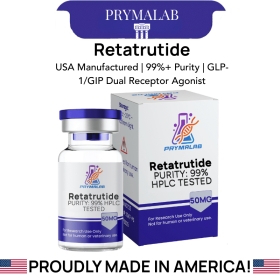
Retatrutide is also stocked as Retatrutide 5mg, Retatrutide 20mg, Retatrutide 30mg, Retatrutide 40mg, Retatrutide 50mg and Retatrutide 60mg. Each listing states its own quantity and concentration, and the pen and vial comparison explains what changes between formats.










Reviews
There are no reviews yet.